"We are a systems lab, not a signal seller"

We research and develop predictive solutions built on real-time market data, mathematical models and quantitative signals — systems you can audit, not black boxes you have to trust. We build tools for trading on your own terms: your wallet, your keys, always under your control. Market Edge Smart Helper is the first.

Market Edge Smart Helper

M·E·S·H is a model for market analysis and decision-making: it reads the state of the market, filters it by regime and volatility, evaluates the real edge against risk, decides and acts, and also controls and monitors itself every cycle. Always under your own settings and your rules.

M·E·S·H dashboard

Quorum Convergence Principle

The theory behind it

Quorum Convergence Principle is a theory developed by Mesh Forge Labs, combining general systems theory and the biological phenomenon of quorum sensing into a single operating principle for automated decision-making. It isn't a metaphor bolted onto a trading bot after the fact — it's built on two ideas that already exist and predate M·E·S·H.

The first comes from systems theory: a set of interacting parts can produce a property that none of the parts have on their own. Biologist Ludwig von Bertalanffy formalized this in the mid-20th century — organize enough interacting elements, and the whole exhibits behavior that can't be explained by looking at any single element in isolation. A single filter checking volatility doesn't know anything about whether to enter a trade. A decision is a property of the whole set of checks, not of any one of them.

The second is a real biological mechanism: quorum sensing. Bacteria constantly release small signaling molecules into their environment, independently, with no coordination between them. While the concentration stays low, each bacterium behaves on its own. Once the concentration crosses a threshold — a quorum — the entire colony switches behavior at the same instant: producing light, forming a biofilm, whatever that species' collective response is. No single bacterium decided anything; the decision emerged from enough independent signals crossing a threshold together.

Quorum Convergence Principle applies that same structure to a decision-making system: independent checks (points) emit their own state without knowing about each other; once enough of them agree within a defined scope, the system as a whole crosses its threshold and acts as one. Puls is the name for that moment of convergence — not a step in a pipeline, but the instant the whole becomes more decisive than any of its parts.

Point

The atomic unit of the system. A single check — an edge threshold, a volatility regime, a risk constraint — with exactly two states: red (unmet) or green and pulsing (met). A point never acts by itself; it only reports its own state.

Scope

The fixed set of points a given decision depends on. Each type of decision pulls from its own scope — the exact points that have to be evaluated together before that specific action is even considered.

Quorum

The minimum combination of green points a scope needs before it's allowed to act. Quorum isn't unanimity — a scope can require 3 of 4 points, or all of them, depending on the strategy. Tightening the quorum reduces false signals; loosening it increases how often the system finds an opportunity.

Puls

Not a fixed stage — an event. Puls is what a scope's points become the instant they cross quorum: a single unified actor that inherits the authority to execute the action that scope was built for.

The five events, every cycle

  1. Emission — every point evaluates its own condition independently, continuously.
  2. Evaluation — the system counts green points against the scope's quorum in real time.
  3. Collapse — once quorum is reached, the points merge into Puls.
  4. Action — Puls passes through the Decision gate and executes.
  5. Dissolution — Puls dissolves back into the next scope's points, which restart from red.
quorum_met = count(points == GREEN) ≥ Q(scope)

Prediction market

The concept

In a prediction market, every X-minute window opens a new market cycle for a given asset and sets a price to beat (PTB) the moment it starts. The core goal is to place an order that predicts whether the asset's price will end above or below the PTB.

The price to beat

When the window opens, the asset's current price is locked in — the price to beat (PTB), the single reference the whole cycle is measured against.

Two sides, one close

The market pays whoever called it right on whether the asset ended above or below the PTB — no nuance, no middle ground.

It never stops repeating

Every window is a new, independent cycle — many opportunities a day for a real signal to prove itself, or get discarded.

Price is probability

Each side trades between $0.01 and $1 — that price reflects the market's implied probability of the outcome. At close, the winning side settles at $1 and the losing side at $0.

progress chart (minutes) — illustrative
— price to beat ▲ buy up ▼ buy down
price_to_beat63,040.01
current_price63,045.70
fair_prob54.2%
market_price49.0%
edge+5.2%

Prediction in a binary market

In every window, the asset's real volatility has to be measured, the moment classified into a zone, a "fair" probability calculated for whether the price will go up, and that compared against the price the token trades at in the market right now. M·E·S·H handles all of these calculations, and if the difference — the edge — is still large enough even after paying the real purchase price, and the rest of the risk filters allow it, it buys in. If not, it waits for the next cycle. Given how much markets vary in volatility and behavior, three volatility zones are considered:

Each zone has its own parameters — token price range, minimum movement, minimum edge, Kelly fraction and max bet — because optimal behavior changes with how much the asset is moving. Everything is adjustable from the Parameters panel, no code required.

Low Zone

The asset's price stays very close to the PTB for the whole window — it barely moves. The token trades near $0.50, close to equilibrium, making a real edge harder to find: the minimum required goes up and bets get smaller.

Normal Zone

The asset moves a normal amount relative to the PTB — neither stuck nor spiking. It's the market's most common regime, and default parameters are tuned with this case in mind.

High Zone

The asset drifts far from the PTB in a short time. The token trades closer to the extremes ($0.10 or $0.90) — sharper probabilities, more opportunity, but also more risk that the move is just noise that reverses.

The edge

P(UP) = N( d / (σ·√t) + momentum_adj ) edge_UP = P(UP) − token_price_UP

It's the gap between what the market charges for an outcome and the real probability it happens. If the market is pricing something at 50% while momentum, volume and order flow point closer to 65%, that's an edge — a measurable advantage, not a hunch.

M·E·S·H first calculates a "fair" probability that the price will close up, using an option-pricing-style formula that combines how far the price has moved, how much time is left in the window, and real volatility. That probability is compared against the token's price — the difference is the edge.

The calculation runs twice: once with the market's mid price, and again with the real price you'd actually pay (the "best ask").

simulated parameters
d (BTC move)—
σ (volatility/s)—
t (seconds left)—
momentum_adj—
token_price—
P(SUBE) = N( … ) = — edge_SUBE = —

Market Edge Smart Helper - BTC 5 min

What is M·E·S·H? And how it works?

M·E·S·H (Market Edge Smart Helper) is a decision-making model for prediction markets. It reads the market, filters it by risk and volatility, and only acts when its independent checks — the points — agree at once, following the Quorum Convergence Principle, including hedge orders and loss-safety measures.

M·E·S·H runs on 5-minute BTC prediction markets on Polymarket: every cycle it reads the price, computes the edge and decides whether to enter — fully automatically, with no manual intervention. It runs 24 hours a day, in Simulation or Real, and surfaces every decision on a local dashboard so you can follow it live.

No single check should ever carry a decision by itself. Any complex decision can be broken down into a set of independent checks — each one with exactly two states: unmet, or met. We call them points. No single point can act on its own. A decision is what happens when all of them agree at the same time, based on our Quorum Convergence Principle, and all this is happening in M·E·S·H. That convergence has a name: Puls, the emergent actor formed the instant enough points line up.

Ease of operation

Installs and starts in minutes. One dashboard controls everything: pause, switch between Simulation and Real, adjust parameters — no code, no terminal.

Cross-platform

Windows and Linux, as a desktop app. Packaged as a native executable — no need to install Python or dependencies.

Built-in VPN

Mullvad VPN, one click. Turns on from the same dashboard and keeps the connection stable throughout.

Simulation and Real

Test without risking capital. When you're ready, switch to Real from the same panel — no restart needed.
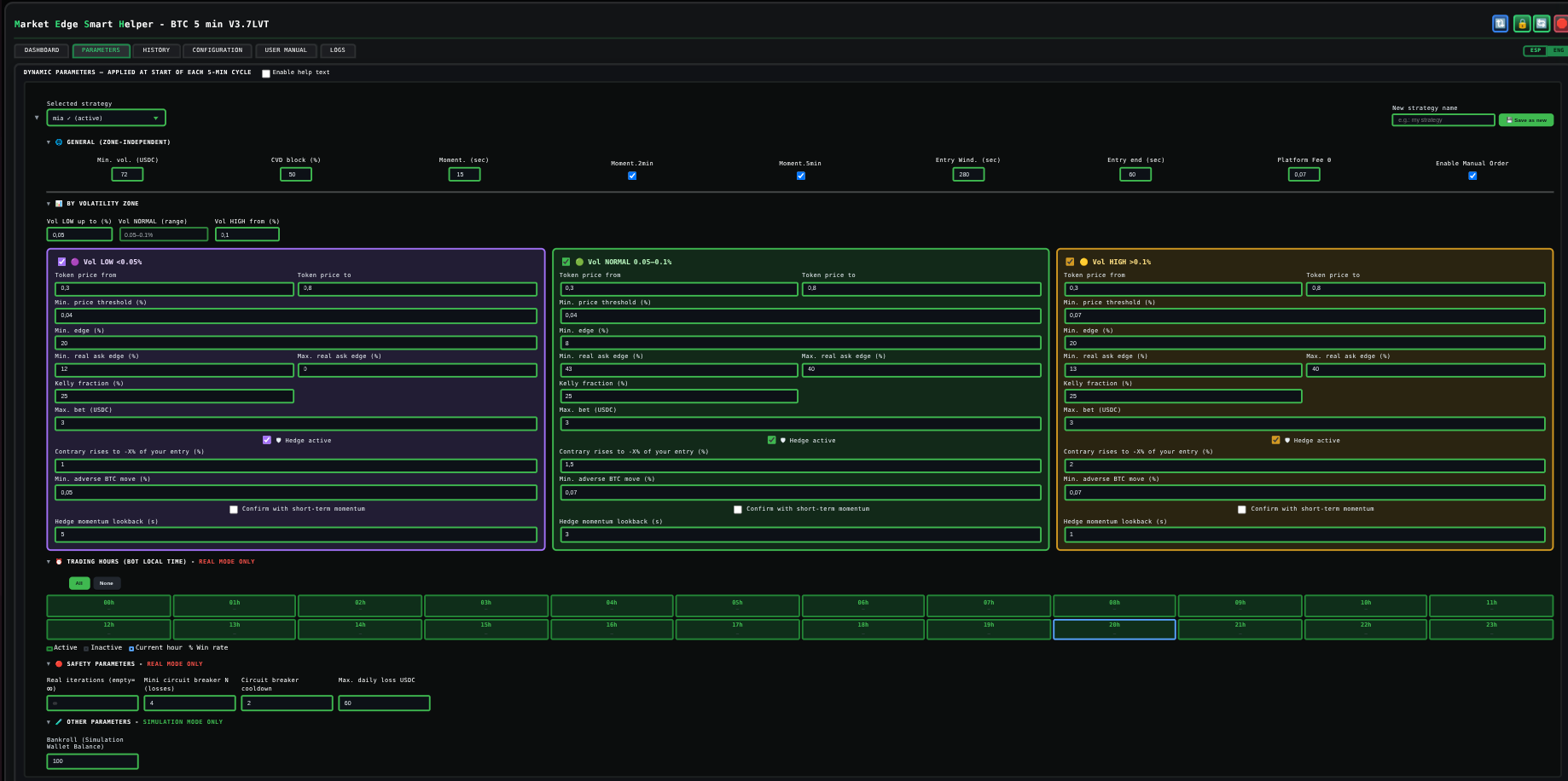
M·E·S·H dashboard — parameters and strategies
Parameters and strategies — one strategy per volatility zone (Low/Normal/High), each with its own thresholds, hedge settings, trading hours and safety limits, all editable with no code.
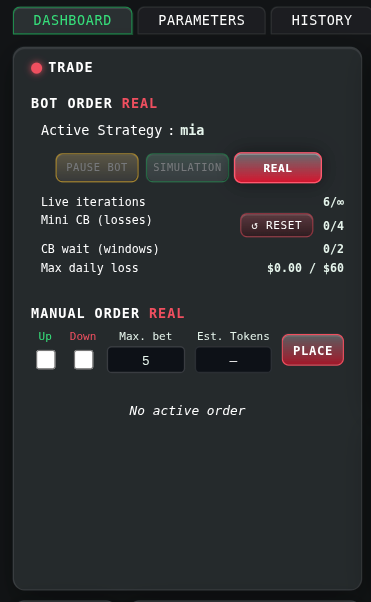
M·E·S·H dashboard — live operation
Live operation — pause, switch between Simulation and Real, launch a manual order, and watch every safety counter update in real time.
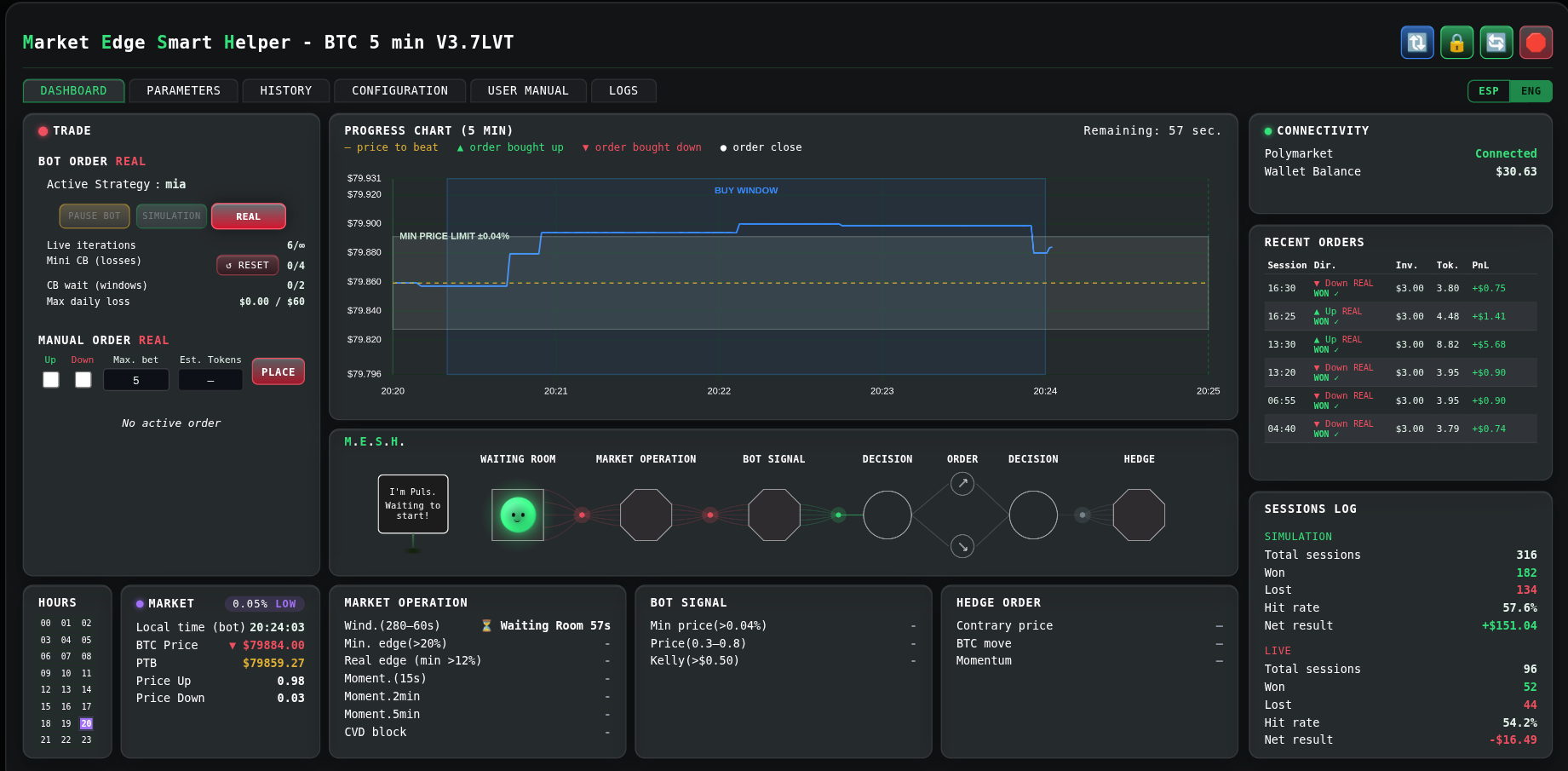
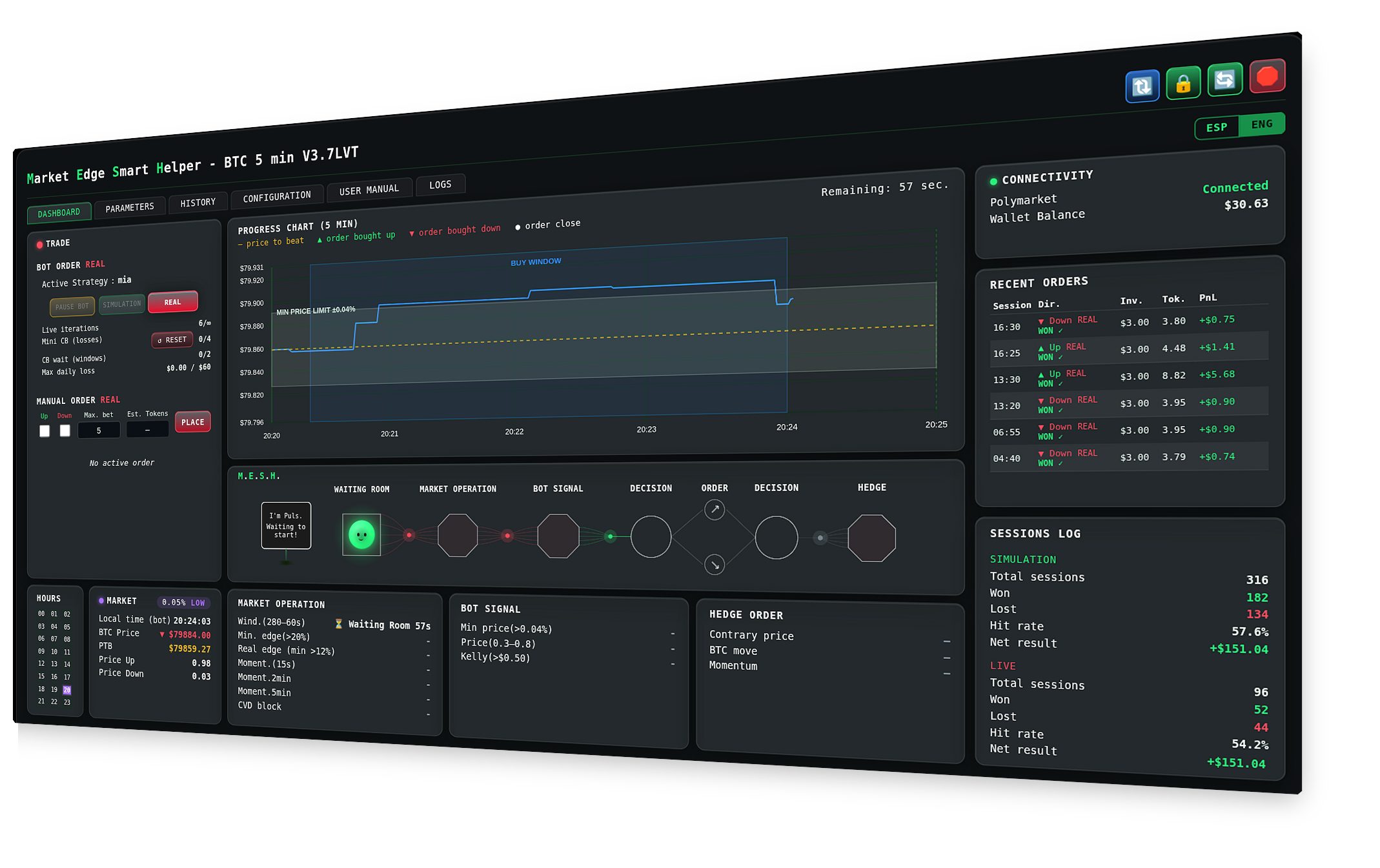
M·E·S·H dashboard — full overview
Full dashboard — live progress chart, market and bot signals, the M.E.S.H. flow diagram, and session history, all updated every cycle.
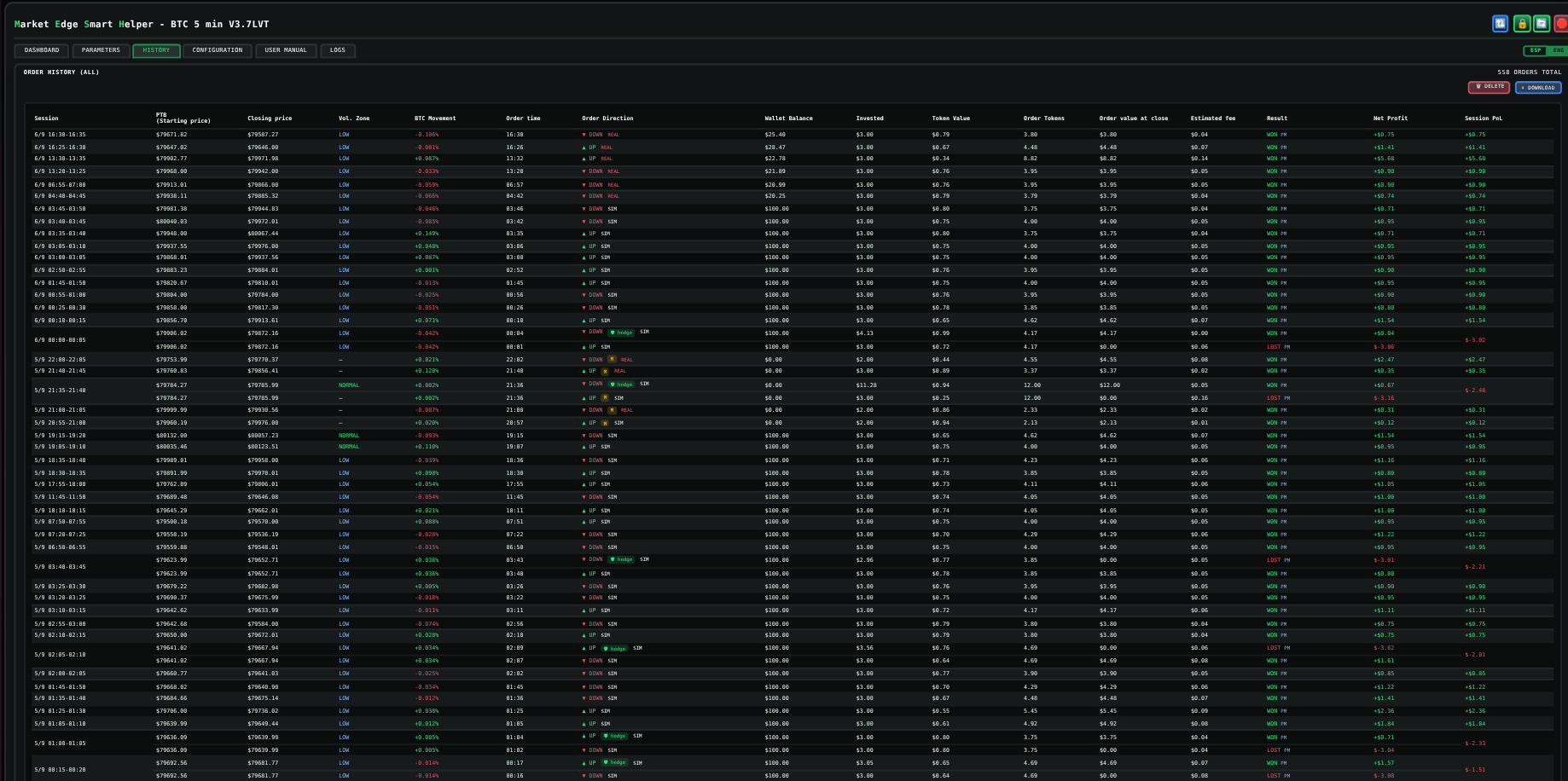
M·E·S·H dashboard — order history
Order history — every closed trade, with its result and net profit, available to audit at any time.

Safety and control

Different operating and safety modes, including specific controls for Real trading.

Two independent quorum circuits, not one

M·E·S·H never decides on a single number. Every cycle runs a set of independent checks — filters, edge calculations, risk constraints — and each one only has two states: unmet, or met. We call them points, same as in the base theory. No single point can act on its own; a decision only happens once enough of them agree within their scope.

M·E·S·H uses Quorum Convergence Principle as its base theory and extends it with an added layer of safety built specifically for loss control and hedging — reducing how much value a losing trade can take from the account. In a prediction market, this means M·E·S·H doesn't run a single quorum — it runs two, and they never share authority.

The Entry Quorum is the one already described in "The edge": minimum edge, real edge after the actual purchase price, momentum confirmations across three timeframes, CVD, and the entry window all have to reach quorum before a position is even opened. This circuit's only job is to find opportunity.

The Hedge Quorum is the added safety layer — a second, fully independent circuit that only starts watching once a position is already open, and whose only goal is capping how much a losing trade can cost. It never looks for more profit; it looks for evidence the trade is going wrong. Its points are different from the entry scope's: contrary price movement, a BTC macro move working against the position, and momentum reversing. If enough of these points turn green before the window closes, M·E·S·H fires a hedge order that reduces exposure and caps the loss — instead of riding it to the worst possible outcome.

A third layer sits above both, at the portfolio level. The daily circuit breaker below isn't watching a single trade at all — it's its own quorum, evaluated across the whole day: total loss reached, or a streak of consecutive losses. Once that outer quorum trips, new entries stop completely, regardless of what any individual Entry or Hedge Quorum says, until you decide to resume.

The result is three nested safety nets: one decides whether to enter, one decides whether to cut a loss short while it's still open, and one decides whether to keep operating at all that day.
⏸

Pause, instantly

Stops new entries from the next second, without shutting down the bot or affecting an order that's already open.

🔁

Simulation instantly, Real next cycle

Switching to Simulation applies immediately. Switching to Real takes effect at the start of the next cycle, to avoid acting on partial market data mid-window. Every time you switch back to Real, the consecutive-loss counter resets to zero.

🛑

Daily limit & circuit breaker

Cuts off Real trading once the day's max loss is hit or after a streak of consecutive losses — until you decide to continue.

⚙

Hot parameters

Any change to thresholds or zones stays pending and only takes effect at the start of the next window — never mid-decision.